
Gawler East
Gawler East sits on the rise above the town, and most yards here have a fall in them. We set the ground first, then build on levels that stay put.
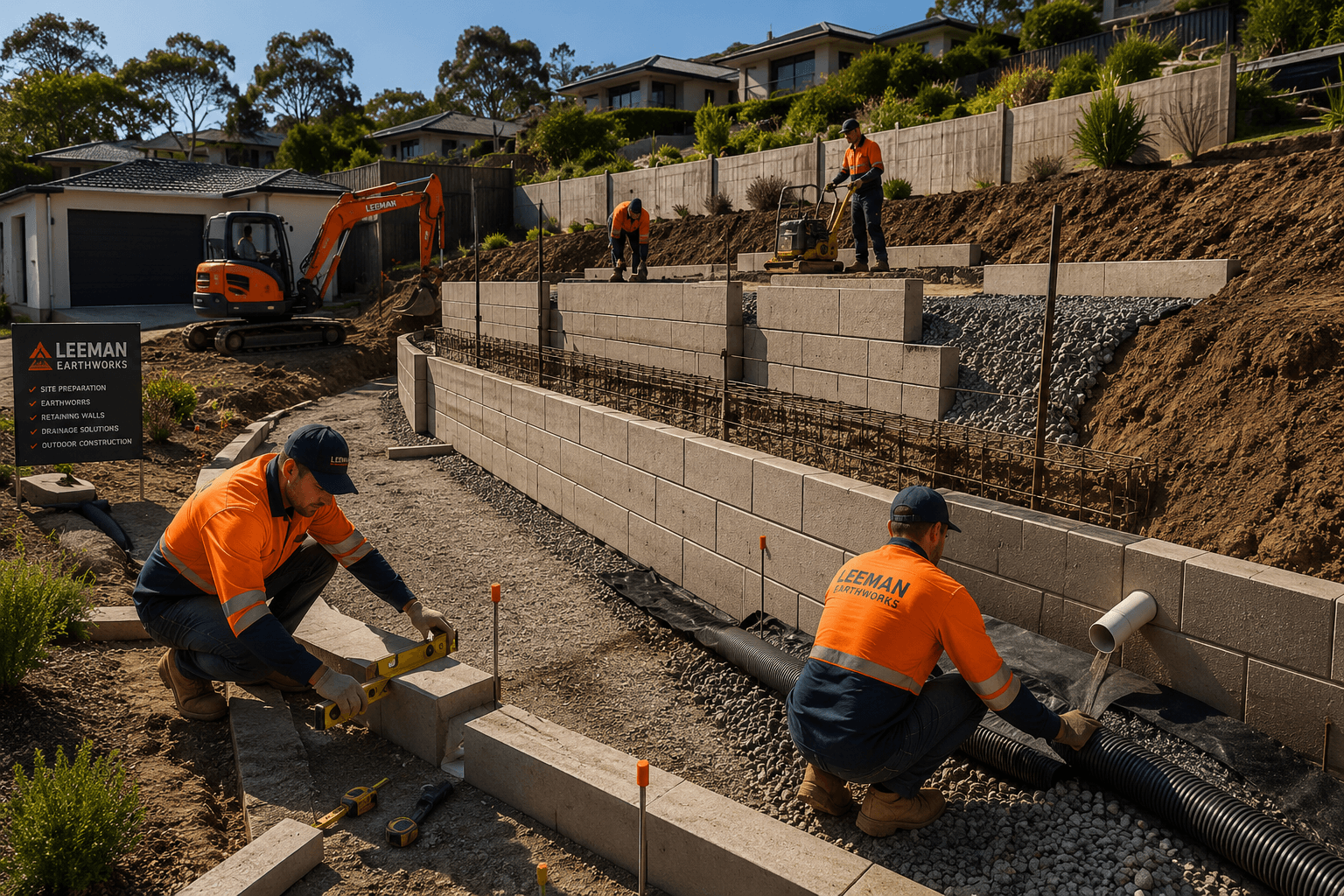
On a sloping block the order is decided for you. Ground gets cut, held and drained before a paver or a roll of turf goes down.
Concrete sleeper, block and rock walls sized to the bank behind them, with drainage and backfill built in as the courses go up.
Taking the high side down and bringing the low side up, until the block has a level you can use.
Runoff caught above the house and given a line to follow, rather than finding its own way down.
Sloped driveways, linking paths and paved terraces, set out so the grade is walked in steps.
Lawn on graded ground, with sprinkler spacing that allows for a slope from top to bottom.
Boundary fences stepped down the grade, on posts set into ground already cut to height.
Cut material reused on the block as fill, or loaded out by the truck if it is no good.
Groundwork and finish run as one job here, which is how our landscaping services are set up. If your block sits down on the flat, read landscaping in Gawler instead.
The first job on a block up here is working out how far the ground drops and which way it runs. That one measurement decides most of the yard. It sets whether you get one flat area or two, where a wall has to sit, and which corner the runoff finishes in.
Levels get shot across the whole block before we price anything, so the design starts from real heights. A grade that feels mild underfoot is usually steeper than it looks once it is written down.
From there it is a choice of three. Grade the fall out, split it into terraces, or leave part of it as a planted bank. Most yards use all three. The flat goes where you will use it, and the rest of the slope gets pushed to an edge.
The machines and the operators are ours, so the crew reading the levels is the crew building on them. Our checklist for preparing a site covers that first visit.
Every level yard on a grade comes from cutting, filling, or a bit of both.
The level is dug out of the bank. The ground under it has never been disturbed, so it is solid from day one.
The level is made by bringing material up instead of taking it away. Less leaves the block, but what goes on has to be placed with care.
Moving the ground is the straightforward part. Keeping it where you put it is the part worth spending on.
Soil tipped in one go on the low side looks level on the day and settles over the winter. Paving laid on it cracks, and posts set in it lean. Fill goes down in thin layers, each one compacted before the next, so made ground behaves like the ground beside it.
Every wall on a grade has water arriving behind it. Agricultural line, aggregate backfill and an outlet go in as the courses rise. Leave them out and pressure builds until the wall bows forward, which is why so many older walls up here have gone out of line.
Where the drop is more than one wall can sensibly hold, the yard gets split into levels instead. Lawn on one, paving on another, a planted bank between them. Steps and a path have to tie the levels together, or the top one becomes the part nobody walks to. If an outdoor entertainment space is in the plan, its level is fixed first and the rest is built to suit it.
Access shapes the price of a yard up here as much as the design does. A machine that can reach the back turns a fortnight of barrow work into a couple of days. What we look at:
We match the machine to the gap. Narrow excavators and tracked barrows get through openings a bobcat will not, and tracks spread the weight so ground you are keeping survives being driven over. Where nothing fits, a fence panel comes out and goes back at the end.
On a grade there is also the question of what the machine stands on. Loose cut material stacked at the top of a slope is not a working platform. We bench a flat pad to work off, then take it out on the way down. Spoil is worth planning early, because a cut yard makes more of it than owners expect. Our guide to what earthmoving and site prep involves covers that side of a job.
Five stages. On a slope they run in this order for a reason.
We walk the block with you and take levels, so the plan starts from heights rather than guesses.
A layout showing where each flat area sits, what holds it up, and where water gets out.
Ground is moved, fill goes down in layers, and drainage is in before anything covers it.
Retaining, steps, paving and fencing, built up the block from the lowest level first.
Topsoil, lawn, irrigation and plants go on once nothing above them is going to move.
Our excavators, bobcats and trucks run out of Mannum and Waterloo Corner, and this end of Gawler is on the regular route.
Blocks change character quickly here. Older yards behind the town are covered under landscaping in Gawler South, while newer estate ground reads more like landscaping in Evanston Park or landscaping in Willaston.
Not always. Where the fall is gentle we grade it out with earthworks alone. Once the drop leaves a bank too steep to mow or plant, a wall is the cheaper way to hold it.
Usually. We match the machine to the access, and tracked gear spreads its weight so the ground you are keeping is not chewed up. Where nothing fits down the side, a fence panel comes out for the job.
Sound material stays on the block and gets reused as fill where the yard needs building up. The rest is loaded out. The loads are counted in the quote, so cartage is not a surprise later.
Cutting a yard flat removes the path water used to follow, so a new one has to be built. Falls are set across every surface and a drain line run out to the stormwater before anything covers the ground.
Longer than the same yard on flat ground, because the cut, the walls and the fill all come before the visible work. You get a timeframe with the quote, and the job can be staged.
We walk the slope with you, take the levels, and come back with a layout and a price for the whole yard. The visit costs you nothing.