
Angle Vale and the northern plains
Acreage, semi-rural and estate blocks. We work out how much of the property you actually want built, then build that part properly.
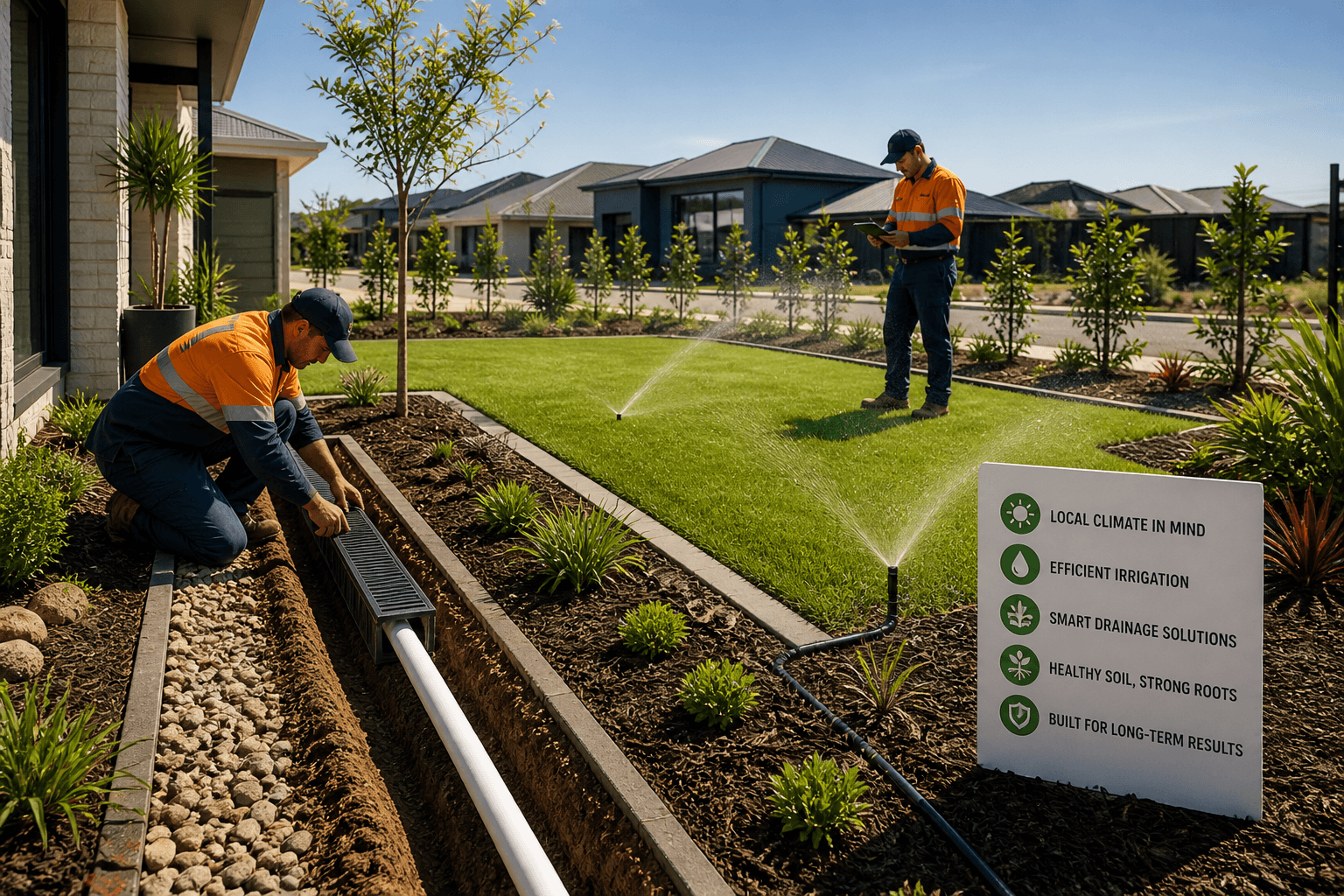
Our landscaping services and our earthmoving side are one crew, so a big block does not get handed between trades halfway through.
A drawn line between the part of the property that gets finished and the ground that stays open, settled before a machine turns up.
Long driveways, turning circles and parking aprons built to carry a loaded trailer, not just the family car.
Concrete sleeper, block and rock walls to hold a bank, square up a pad or lift a lawn out of the surrounding ground.
Falls shaped across long runs, ag drain where water has nowhere to go, and trenches for the services a big yard needs.
Lawn sized to what you are willing to water, on a system split into zones so no single line is asked to do everything.
Boundary runs, an internal house yard fence, and gates set wide enough for whatever has to come through them.
Cut material, old rubble and cleared growth carted off, or shifted to a corner of the block where it does some good.
Angle Vale runs from new estate streets out into farmland, and we work both ends of it. Nearby we also take on landscaping in Two Wells and, closer to town, landscaping in Evanston.
The common mistake on a large property is treating the whole title as a garden. Mowing, watering and weeding an acreage-style block turns into a second job, and the money spreads so thin that nothing looks finished. A defined area built properly beats a whole block done lightly.
So the first thing we do is walk the property with you and peg where the built area stops. That line usually follows how you already live on the place: the back door, the run to the shed, the washing line, the flat bit the kids use.
Inside the pegs the ground gets levels, drainage, edging, surfaces and irrigation. Outside them it gets a mowing pass and a plan for later. Staging it that way costs less than trying to hold a whole property to garden standard from the first year, and it gives you something finished to sit in while the rest waits.
A suburban yard has a fence to work back to. On semi-rural ground there is often nothing telling you where the landscaping ends, so the edge has to be built rather than found.
With no boundary close by, a garden trails off into rough grass and looks unfinished no matter how good the middle of it is. A mown strip, a change of surface, a low wall or a run of trees all do the same job. They tell the eye that this part is the yard and the rest is paddock. We pick whichever one suits how you use the ground beyond it, then set it out on site rather than on paper, because the right line is obvious once you are standing on it.
Wind crosses open plains ground with nothing to slow it down. New plants burn off on the windward side, young trees lean, and mulch ends up piled against a fence. A staggered line of hardy trees or shrubs on the exposed side fixes most of that, along with stakes that are actually up to the job and a mulch coarse enough to stay put. Put that in first and the softer planting behind it has a chance.
One tap and one controller will only run so many sprinklers at once, so a big area gets split into zones and watered in sequence rather than all at once. Beds do better on drip under mulch than on spray, because less of it blows sideways before it lands. Lawn stays at a size you are happy to water through summer, and hardier planting takes over past that point. Worth settling early: natural turf against artificial grass.
Angle Vale has plenty of both, and they are not the same job. Which one you have changes the scope, the machines and the order of the work.
Fenced, close to the neighbours and handed over with the yard untouched. The work is detailed and tight, and access sets the pace.
Room to move and no fence line to hide behind. The work is bigger and simpler, and distance decides most of it.
On a bigger property nothing has to be barrowed down a side path and no bobcat gets lifted over a fence. A tipper backs to the spot the material is going, and that alone takes days out of a build.
The other half of access is what you drive. A driveway that suits a car will not suit a car towing a boat, a float or a tandem trailer. We peg the run and the turning area out with your own vehicle hooked up, walk the swing through the gateposts, and check you can come back out without a three point turn across the lawn.
Under a driveway that carries weight, the base matters more than the surface. A thin bed of rubble will rut and crack no matter what goes on top of it, so we build for the heaviest thing that will ever use it and pick the finish afterwards. Once the hard surfaces are down, an outdoor entertainment space is the usual next stage.
Shed pads, water tank stands and turning aprons get set out at the same time as the driveway, because they all share the same base work and the same falls.
Nothing here prices by the square metre alone. On acreage, a short list of things does most of the work.
The share of the property that gets finished, rather than the size of the title.
Long runs of pipe, cable, drain and edging add up quietly on a wide block.
Even a gentle fall over a wide area shifts a surprising volume of dirt.
Usually a saving out here. Open access means bigger gear and fewer days on site.
How many zones the area needs, and how far each line has to reach.
Cut material can often stay and be shaped on site, which cuts the cartage right down.
The quote comes back split by area and by stage, so you can see what a smaller built footprint would save you. Plenty of jobs out here run in two goes: driveway, levels and drainage while the machines are on the property, then lawn, planting and the outdoor living end once the ground has settled. You can see finished work of both kinds in our projects gallery, and our note on what landscaping does for property value is worth a look if you are weighing up how far to go.
Five stages, from the first walk over the property to the day it is handed back.
We cover the block with you and peg where the built area is going to stop.
A layout for the house yard, the access and the open ground, costed by stage.
Pads cut, falls set over the long runs, drainage and conduit into the ground.
Driveway, walls, paving and fencing while the block is still open to machines.
Topsoil, turf, irrigation and the shelter planting go in at the end.
Our machines live at Waterloo Corner and Mannum, which puts the northern plains a short run away. Ground we are on regularly:
A few minutes up the road the ground and the blocks both change, and so does the job. See landscaping in Evanston Park for the estate side of it, or landscaping in Gawler for town blocks on heavier ground. Somewhere else? Ring 0483 905 611 and tell us where the block is.
Yes. Larger properties suit the way we work, because we run our own excavators, bobcats and trucks, and there is usually room to bring them straight onto the block instead of squeezing gear down a side path.
No, and on a big property most people should not. We mark out a house yard that gets built properly and leave the ground past it as open paddock or slashed grass. You can extend the built area later, and it is far easier to look after in the meantime.
It depends on what you tow and where it has to turn. We peg the run and the turning area out on the ground with your own vehicle and trailer before anything is built, so the space is proven rather than guessed at from a plan.
Shelter goes in before the display planting. A staggered line of hardy trees or shrubs on the exposed side, proper staking and a coarser mulch will carry young plants through their first couple of summers.
The figure comes off how much of the block you build, not the total size of the title. Distance across the site, how far the levels move, irrigation zones and what has to be carted away all count. The site visit and the quote cost you nothing.
We walk the property with you, peg where the yard should stop, and put a price on the part that gets built. The visit costs you nothing.