
Evanston Park and the newer estates
Estate homes hand over with the house finished and the yard bare. We take a block from builder's ground to a front and back you can use.
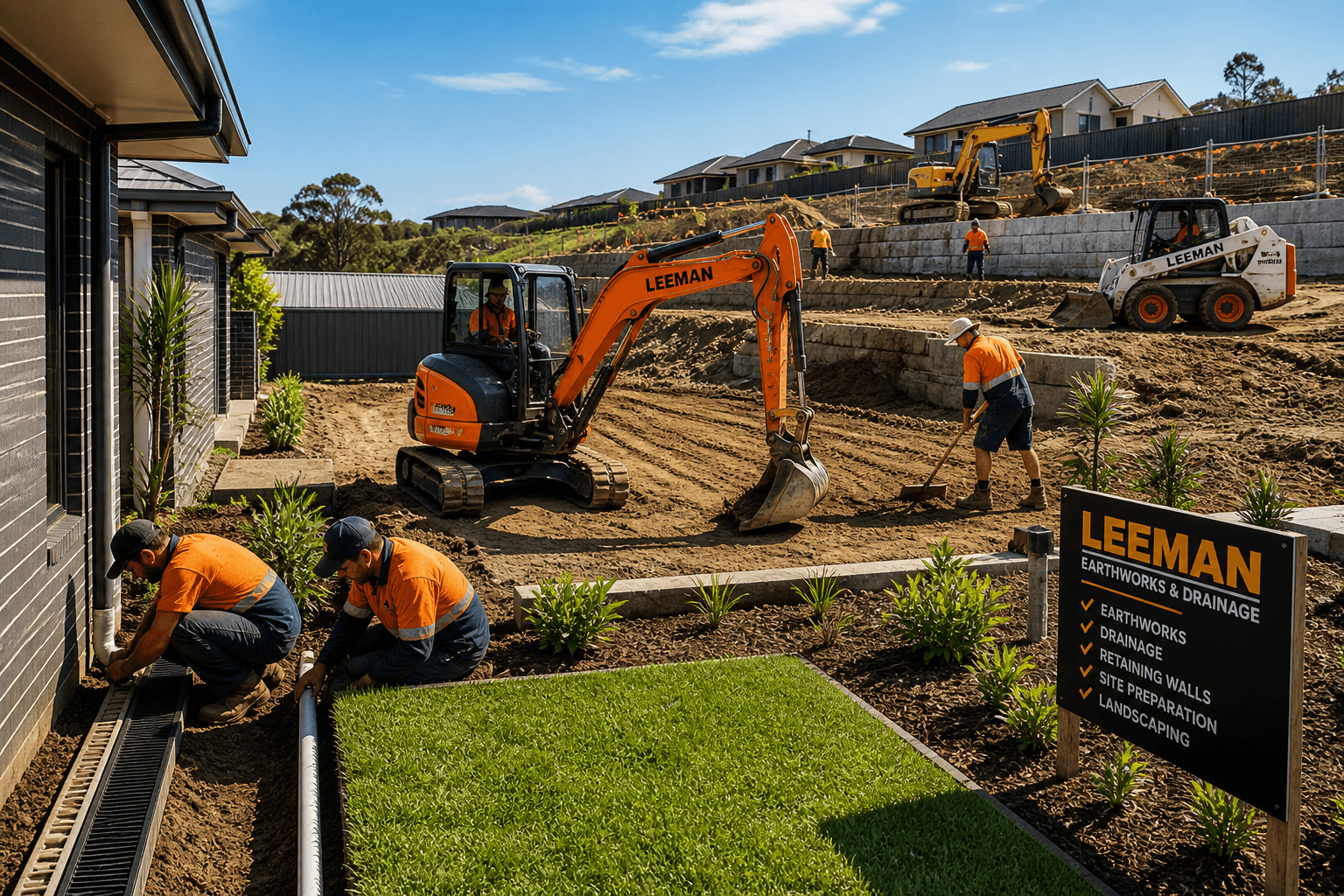
A handover yard wants earthworks before it wants plants. One crew does both, which is how the same ground gets dug up once.
Builder's ground graded, loose fill dealt with, and the block set to the heights the yard needs.
Surface falls, ag drain and connections put in while the ground is still open.
Exposed aggregate, concrete and brick, meeting the crossover and the front door at the right height.
Boundary and terrace walls holding the step between your block and the next.
Front and back lawns given a proper base, not rolled over builder's fill.
Dividing and boundary fences built once the finished ground height is known.
Surplus sand, rubble and fill taken off the block, not raked across the yard.
Our landscaping services run across the front and back together, and the site preparation checklist covers what we look at first.
The house is signed off, the yard is not, and what you stand on at handover is rarely anything you could call garden soil. On most estate blocks it is a mix of:
None of it grows much, and none of it is compacted evenly. Turf rolled over the top looks right for a season, then dips along every trench line and thins where the ground went hard.
It also sits at the wrong height. Ground is left high against the slab in one spot and low in another, while a finished yard has to fall away from the house on every side. Correcting that means moving material, not tipping topsoil over it.
So the first day on a handover block is measuring. We shoot levels front and back, find the stormwater points, mark the service runs and work out how much ground can stay. What earthmoving and site prep involves covers that stage further.
Estate yards often get built in pieces over several years. It is understandable, and it is the expensive way.
Machines come and go, access is opened up again, and materials arrive in small deliveries instead of one. Laying the lawn this year and the paving in two means paying for that setup twice, and the second visit is the harder one, because the first is in the way.
A machine crossing a finished lawn to reach the back corner leaves ruts and hard ground behind it. A path poured before anyone knew where the shed was going gets cut through. Plan the whole block in one go and the sequence protects whatever is already finished.
One project does not mean paying for it all at once. It means one plan and one set of levels, then building in the order that plan sets. Groundwork, drainage and hard surfaces come first. Planting, and a pergola, deck or alfresco area, can follow later without anything being lifted. What cannot wait is the conduit, the falls and any slab, because surfaces close over those for good.
The same block, the same budget over time, and two quite different yards at the end of it.
Levels, drainage and layout settled before anything permanent is put down.
Each stage designed around whatever happened to go in the year before.
Two things go into an estate yard early and are painful to move later. The fence and the shed. Both usually arrive before anyone has looked at the ground under them.
A fence set into ground that is later cut down finishes with a gap under the palings. Set into ground that is later built up, it holds soil and water against the boards. Where your block steps up or down from the neighbour's, the retaining belongs in before the fence, not squeezed in behind it afterwards.
A shed goes the same way. Sat on builder's fill it settles at one corner, and once it racks the doors stop meeting. It wants ground falling away from it and a path that stays walkable in winter.
The gate is the small item that costs the most. If the only way into the back is a standard gate, every future load, mower, trailer and machine has to fit through it for the life of the house. Widening it while the fence is still going up costs very little. The same order applies on new blocks in landscaping in Angle Vale and landscaping in Gawler East.
From the first look at a bare block to the day the last load leaves.
Levels shot, services and stormwater points marked.
Front and back drawn together, cost split by stage.
Fill sorted, levels cut, ag drain and conduit in.
Hard surfaces built before the fence closes access.
Soil conditioned, turf laid, leftover material carted off.
Evanston Park sits south of town among the newer estates, and that pocket is standard ground for us. Most weeks we are in it, or north doing landscaping in Gawler. Areas we cover regularly:
Estate not on that list? Ring 0483 905 611 with the address and we will let you know. We take on landscaping in Evanston next door as well.
Either works, but draw the plan now. Levels, drainage and conduit cost least while the ground is open, and dear once a lawn and a path sit over them. A common approach is groundwork first, then a return visit for planting.
Yes, and on a handover block that is most of the work. We cut the high ground back, deal with soft fill rather than burying it, and set the block so water runs away from the house.
After the levels are settled, and after any retaining on that boundary. A fence built on ground that is still going to move ends up with a gap underneath, or with soil held against the palings.
Yes, though it is easier if we know where they are going before we start. Both want a level pad, ground that falls away from them and a path that stays walkable in winter.
It is priced per block. The figure moves on how much ground has to shift, how much builder's fill leaves the site, the length of the driveway, and the finishes you pick. The site visit costs nothing.
One visit, one plan for the front and the back, and a price broken down by stage. Tell us when suits and we will come out to the block.