
Two Wells and the plains
Earthworks operators and landscapers in the one crew. Out here the first question is what your ground does with water, because it is rarely what a Gawler block does.
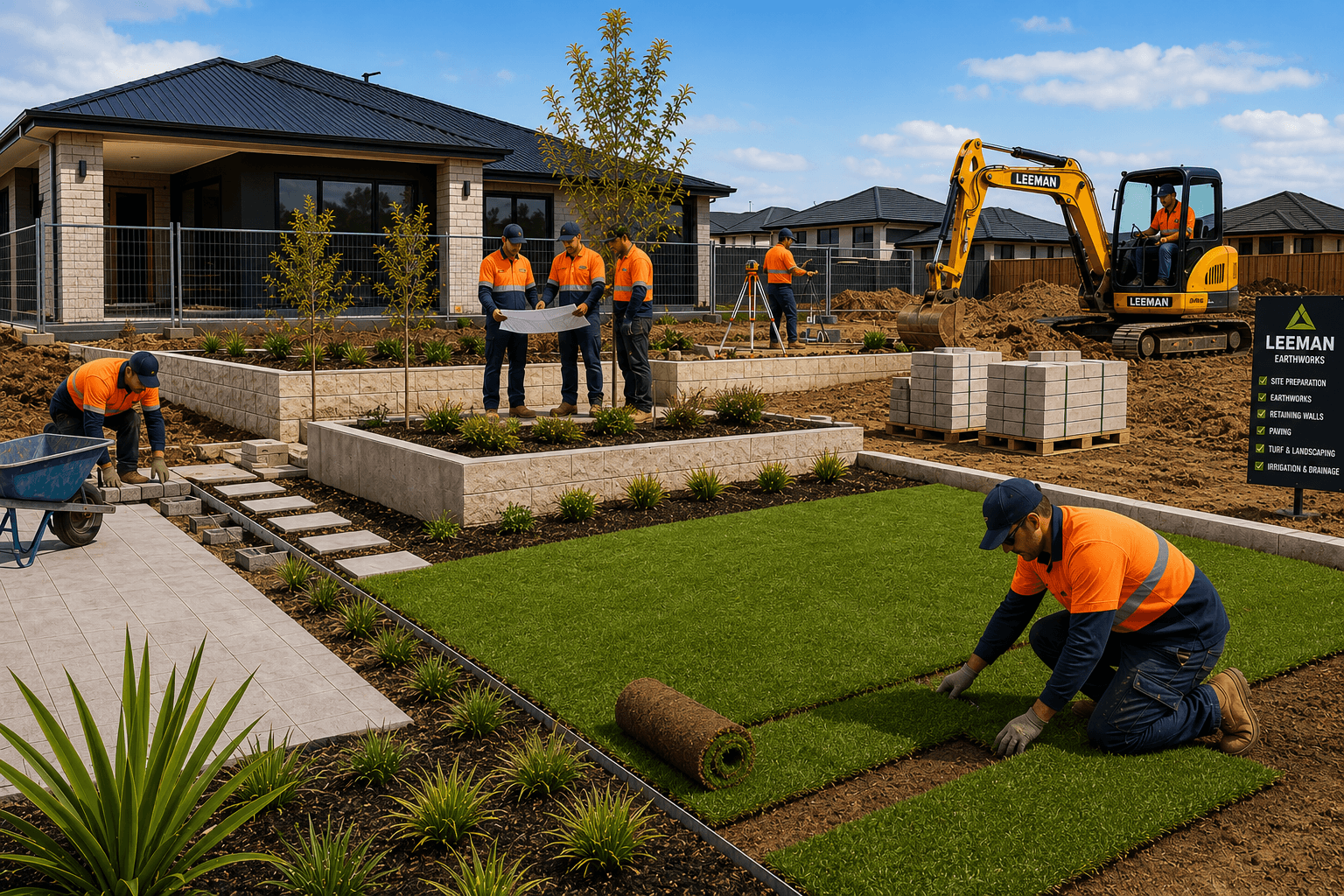
Township blocks on the plains usually give you more ground to play with than a suburban lot, and that changes what a yard needs. We cover the machine work and the finished surfaces, so one crew carries the job from bare dirt through to planting.
Grading a large block, breaking up compacted ground and getting the profile right before a single surface goes down.
Long service runs, irrigation mains and stormwater lines across open ground, cut and backfilled properly.
Concrete sleeper, block and rock walls, built to hold ground that will not always stand up on its own.
Longer driveways and turning areas, with a base compacted to carry a ute, a trailer or a truck.
Soil built up first, then turf and a watering system sized for ground that lets water through.
Boundary and paddock-side fencing, set out on longer runs where the wind gets a good hold of it.
Old fill, rubble and cleared vegetation carted away so you are not left storing it in a corner.
Not every block needs the lot. The same crew covers the rest of our landscaping services, and single jobs are fine on their own.
Ground conditions change quickly across the Adelaide Plains, and plenty of blocks around Two Wells run to lighter, sandier, free-draining soil. Where that is the case, the problem is the reverse of what a Gawler yard deals with. Instead of water sitting on the surface, it vanishes. What you tend to see is:
That is not a rule for every property. Some blocks out this way carry loam, and some have clay sitting under a lighter layer, which behaves differently again. It can even change from the front of a block to the back. So we dig test holes at the site visit and look at the profile with you before anything is designed.
The distinction matters because the fix runs in the opposite direction. A wet clay yard is about getting water off it. On free-draining ground the job is holding water long enough for plants to use it, and keeping the soil from drying out to dust in February.
If you have moved out from town, this is the part that catches people. What worked on a block closer in may be the wrong call here, and our page on landscaping in Gawler sets out the clay side of it for comparison. Either way, where the water ends up decides the design.
Sandy ground is easy to dig and easy to work. The catch is that it holds very little, so anything you want to grow in it has to be given something to hang on to.
Light soil has almost no structure and very little to store water or feed in. The answer is organic matter, and enough of it to matter. Compost and aged material worked down through the profile, not spread as a thin skin, is what turns loose ground into soil that stays damp between waterings. Wetting agents help where the surface has gone water repellent. Mulch on top slows evaporation and keeps the ground temperature down, which counts for more here than it does on clay.
The long, deep soak that suits heavy clay is largely wasted on free-draining soil. Water heads past the roots and keeps going. Shorter cycles run more often hold moisture where the plants can reach it. On bigger blocks that usually means splitting the yard into zones so the lawn, the beds and any fruit trees are not all on the same timer. Drip line under mulch puts water at the roots rather than into the air, and we lay the mains while the trenches are open rather than cutting a finished yard back up later.
Warm season grasses such as couch and kikuyu handle heat and dry spells better than a cool season lawn, provided the soil under them has been improved first. Turf laid straight onto untreated sand will look good for a month and then thin out. Autumn and spring are the kinder times to lay, when roots can get down before the heat. If you are still weighing it up, our comparison of turf against artificial grass is worth a read, and on a large block it often makes sense to keep real lawn to the area you actually use and treat the rest differently.
Two Wells covers a fair range of property types, from settled township blocks to larger holdings backing onto market gardens and open paddocks. The yard plan changes accordingly.
More space than a suburban lot, and generally room to bring a machine down the side, which keeps the groundwork quick.
Bigger areas, longer boundaries and nothing much between the yard and the weather. Shelter comes before decoration.
There is not much standing between a plains block and a strong wind. That shows up in a yard well before you notice it anywhere else, and it is worth designing for from the start.
A row of hardy shrubs and trees along the exposed boundary does more for a yard than any single feature. It is not there to block the wind outright. Planting that filters it takes the sting out over a good distance and calms everything behind it, which means less watering, less damage and an outdoor area you will actually use.
Chunkier mulch stays put. Drip line under it beats overhead spray. Solid fencing has its place, though it can turn wind up and over into the yard behind, so we usually pair it with planting instead of relying on it alone.
Where an outdoor entertaining area goes is worth settling early for the same reason. The sheltered corner of a block is not always the obvious one, and the levels underneath have to be cut before the surface goes on. Our site preparation checklist covers what gets sorted first.
Each block is quoted on its own. On plains properties the figure usually turns on these.
A large block rarely gets done wall to wall. What you finish and what you leave is the first decision.
Light ground needs organic matter brought in and worked through. That volume is a real line on the quote.
Plains blocks are often close to flat, so there is usually less cutting than on a sloping site.
Distance from the tap and the number of zones matter more here than the sprinkler heads do.
Soil, mulch and base come in by the load, and old material goes out the same way.
Concrete, aggregate, brick paving and gravel all sit at different points on the quote.
You get the figure broken into parts, so it is clear what each stage carries and what could wait. Plenty of larger properties are built over two visits, with groundwork, drainage and the main surfaces first and planting later once you have lived with the layout for a season.
Five stages, from the first look at your ground to the day we clear off the block.
We walk the block with you, dig test holes and find out what your soil actually is.
A plan that suits the block and the conditions, priced stage by stage.
Grading, trenching and any drainage, with our own excavators and bobcats.
Walls, driveways, paving and fencing built while the block is still open.
Soil improved, irrigation commissioned, turf and shelter planting in last.
Our machines are kept at Waterloo Corner and Mannum, so the plains run north of Adelaide is close work for us. Places we are in regularly:
Nearby jobs often run back to back, so ask about landscaping in Angle Vale, landscaping in Roseworthy and landscaping in Willaston if a neighbour is thinking about it too. Somewhere else on the plains? Ring 0483 905 611 and tell us where the block is.
Often it is not. Plenty of plains blocks run to lighter, sandier ground that lets water through quickly, while Gawler tends towards heavy reactive clay that holds it on the surface. Ground varies from block to block out here, and some properties do carry clay or loam bands, so we dig test holes at the site visit and design off what is actually there.
Yes. Two Wells and the surrounding plains country are part of our regular run, and we bring our own excavators, bobcats and trucks rather than hiring machinery in for the day.
By fixing the soil before the turf goes down, not after. Organic matter worked into the profile gives the ground something to hold moisture with, and the irrigation is then set to shorter, more frequent cycles so the water stays in reach of the roots instead of sinking past them.
It is quoted per block. The main things that move it are how much area you are treating, how much soil improvement the ground needs, how far the levels have to shift, the irrigation, and the surfaces you pick. We come out, measure it and price it, and the visit is free.
Yes, and on larger blocks it is often the sensible way to go. We set out the whole layout first so the drainage, conduit and levels are right, then build it in stages that suit you, without redoing work already paid for.
We come out to Two Wells, dig into your ground, and give you a layout and a price built around what we find. The visit costs nothing and puts you under no obligation.